
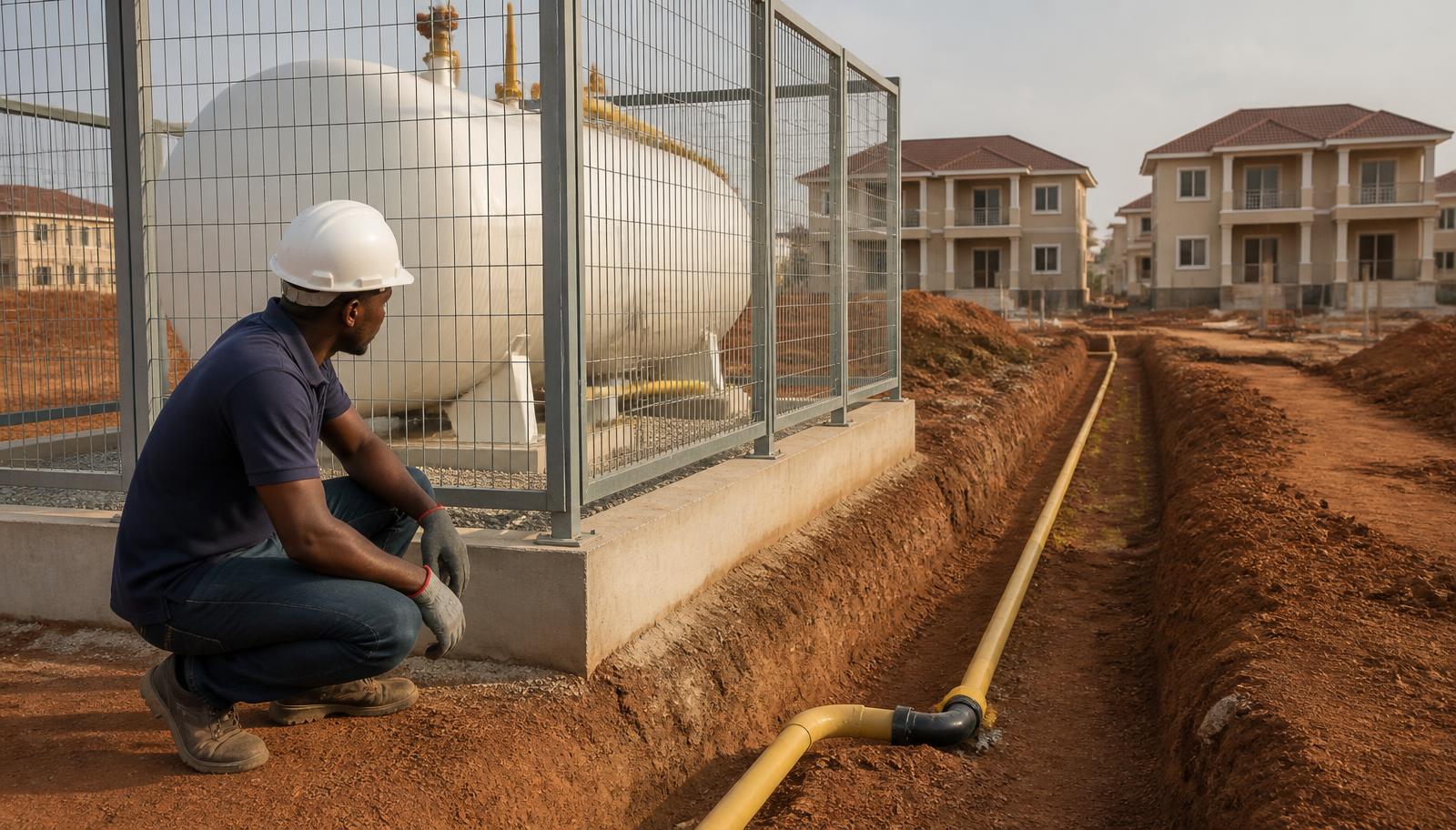
Gas reticulation is a piped LPG system. Instead of each household buying, carrying and swapping cylinders, one central storage vessel serves the whole development through an underground network, and each home is metered at its own connection point.
For developers in Accra, Kumasi, Takoradi and the fast growing areas around them, this has become a practical selling point. Buyers notice it, tenants notice it, and facility managers stop dealing with cylinder deliveries at the gate.
What reticulated LPG actually means for an estate
A reticulated system has four parts:
- Central storage. An aboveground or underground LPG vessel, or a gas bank of cylinders, sized to the number of units and their expected consumption.
- Distribution network. Buried service piping running from the vessel through the estate at controlled pressure.
- In wall piping and appliance connection. Piping carried through each building to the kitchen and appliance points.
- Metering and safety devices. A meter per household, isolation valves, regulators, and leak detection where the design calls for it.
The household simply turns on the hob. Consumption is measured at the meter and billed, in the same way electricity and water already are.
Why estates in Ghana are moving to it
- No cylinders stored inside kitchens or on balconies.
- No trips to the filling station, and no running out mid cooking.
- One professionally maintained system instead of dozens of informal installations.
- Consumption data the facility manager can actually see.
Aboveground or underground storage?
This is usually the first real design decision, and it is driven by land, not preference.
| Consideration | Aboveground vessel | Underground vessel |
|---|---|---|
| Land use | Needs a fenced compound with clearance distances | Frees the surface for parking or landscaping |
| Installed cost | Lower | Higher, because of excavation and coating requirements |
| Inspection | Straightforward visual inspection | Requires planned inspection procedure |
| Best suited to | Estates with space at the perimeter | Dense urban developments and gated apartment blocks |
Both are acceptable when they are installed and tested properly. What is not acceptable is siting a vessel without the required separation from buildings, boundaries and ignition sources. That decision is made on the site plan, long before delivery.
Plan the gas system at foundation stage
Retrofitting a completed estate is possible, and we do it, but it costs more and disturbs finished work. Chasing walls, breaking screed and lifting paving is avoidable.
Bring the gas design in at the same time as the electrical and plumbing drawings, and three things become easy:
- Routing. Service piping runs in coordinated trenches instead of competing with water and cable routes.
- Sleeves and ducts. Wall penetrations are cast in, not cut out.
- Meter positions. Meters end up somewhere readable and safe, rather than wherever there was room at the end.
Sizing the system honestly
Sizing is based on the number of units, appliance load per unit, and how the estate will actually be used. A development with a clubhouse kitchen, a laundry or a standby generator has a different demand profile from a row of two bedroom units. Undersized storage means frequent refills; oversized storage is capital sitting in the ground.
Materials matter more than most drawings suggest
Buried and in wall gas piping is not a place to save money. We use HDPE for underground runs and PEX-AL-PEX composite piping in wall, sourced from ISO certified manufacturers in Europe and the USA. Composite piping resists corrosion, handles the bends a building needs, and reduces the number of joints, and every joint you remove is a joint that cannot leak.
Testing, certification and the bodies involved
A reticulated system should not be handed over on trust. Pressure testing and tightness testing prove the network before it is buried or closed in, and again before commissioning.
We work with the Ghana Standards Authority, the National Petroleum Authority, the Energy Commission and the Ghana National Fire Service so that installations meet the standards that apply to them. For a developer, this matters at two moments: when permits and approvals are being processed, and when a buyer or tenant asks who certified the system.
Billing: prepaid or postpaid
Most estates prefer prepaid. Households load credit and draw gas against it, which removes arrears from the facility manager's workload. Postpaid with bulk metering suits developments where a single entity, such as a hotel or an institution, carries the account. Either way the metering has to be planned, because it affects where meters sit and how data is collected.
Where consumption needs to be visible without a site visit, telemetry and smart monitoring gives the operator tank level and usage data remotely, so refills are scheduled instead of guessed.
Handover and maintenance
A gas network is a live utility. At handover a development should receive:
- As built drawings of the network and isolation points.
- Test and commissioning records.
- Basic user orientation for households, including what to do if they smell gas.
- A maintenance schedule with periodic inspection of valves, regulators and meters.
Estates that skip the maintenance schedule usually discover the gap during a fault, which is the worst time to find out who is responsible.
Frequently asked questions
Is reticulated LPG safer than cylinders in each home?
A properly designed and tested piped system removes cylinders from inside living space, keeps storage in a controlled location, and puts isolation valves and metering under professional maintenance. Safety comes from the design, testing and upkeep, not from the pipe alone.
How long does installation take on an estate?
It depends on unit count, storage type and whether the work runs alongside construction. Networks installed during construction progress with the civil works; retrofits take longer because access has to be created. A site visit and drawing review give a realistic programme.
Can an existing, completed estate be converted?
Yes. Retrofitting completed structures is part of our residential gas reticulation work. The network is routed to limit disturbance, and phasing keeps occupied units usable during the work.
Who is responsible for the system after handover?
Usually the facility management company or the residents association, under a maintenance arrangement with the installer. That responsibility should be written down at handover rather than assumed.
Does each household get its own meter?
In residential developments, yes. Individual metering is what makes fair billing possible, and it also makes unusual consumption easy to spot.
Talk it through before the slab goes down
If you are planning a development, the cheapest time to get the gas system right is now, on the drawings. Our team reviews site plans, sizes storage, designs the network and handles LPG and gas engineering through installation, testing and commissioning.
Talk to an engineer with your site plan and unit count, and we will come back with a practical way forward.
- gas reticulation
- property development
- LPG
- estates