
Centralised storage
Gas is stored in one properly engineered location on the development instead of in cylinders inside each home.
EXCELLO!!! Always Making The Difference…
Residential Gas Reticulation
Reticulation treats gas as an estate utility. A central vessel feeds an underground network, and each home is connected through in wall piping to its appliance point. Designed at the right stage, it becomes part of the development rather than an addition to it.
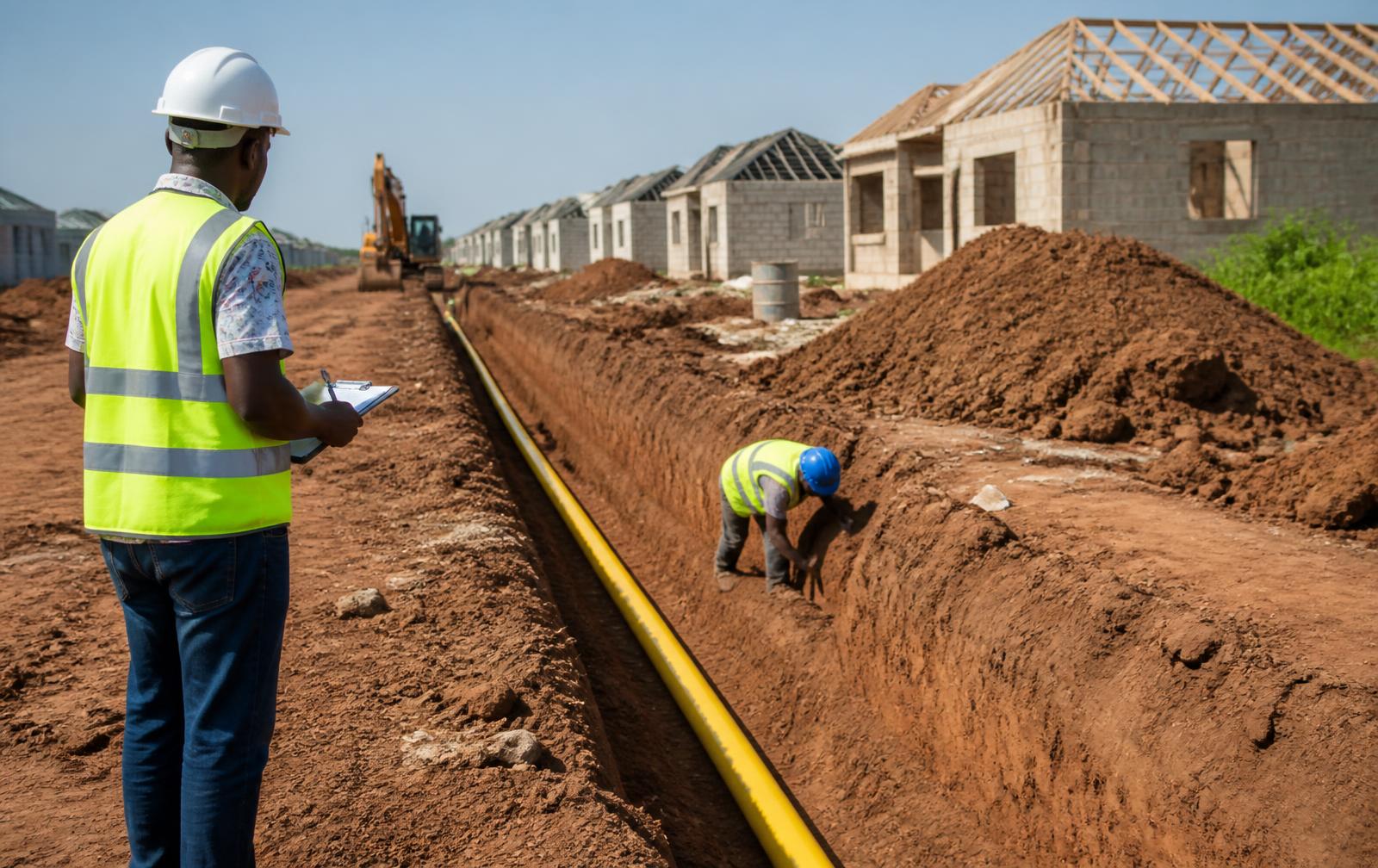
Reticulation is centralised gas distribution. Instead of every household buying and storing its own cylinder, gas is held in a bulk vessel or gas bank on the development and distributed through a network of underground piping. From the network, service lines run into each property and continue as in wall piping to the kitchen and any other appliance point.
For a developer this is infrastructure work. The vessel needs a location that respects access and separation requirements, the network needs a route that fits with roads, water and electrical services, and the whole system needs isolation points so a single home can be worked on without interrupting the rest.
We design and install these systems for housing developments, estates and apartment buildings, and we retrofit completed properties where the layout allows it.
How it works
The concept is straightforward. Gas moves from one controlled storage point, through a designed network, into each home.
How a reticulated system is laid out
A bulk vessel or gas bank is sited and secured on the development, sized against the number of units it will serve.
Buried network piping carries gas from the storage point across the estate, with isolation and metering points along the route.
In wall piping runs from the network into each home and terminates at the kitchen appliance point.
Layout is illustrative. Actual vessel size, pipe routing, metering and isolation points are determined by the site survey and the number of units served.
Why developers consider it
These are practical outcomes of centralised distribution. Actual performance depends on the design, the appliances and how the system is maintained.
Gas is stored in one properly engineered location on the development instead of in cylinders inside each home.
Households draw gas from the network, so the routine of transporting and swapping cylinders is reduced for residents.
Pipe routes are designed with the roads and services, which avoids cutting into finished works later on.
Each unit has a gas point at the appliance, in the same way it has water and electricity.
Individual metering, including prepaid metering, can be built into the scheme so consumption is measured per household.
One network with defined isolation points is easier for a facility team to monitor, service and shut down when needed.
Where it can be used
Reticulation suits developments with enough units to justify central storage and a facility team to operate it.
New schemes where roads and services are still being laid are the most straightforward, because pipe routes can be designed alongside the other utilities.
Gated estates with a facility management team can operate a central vessel and a metered network across all units.
Multi unit buildings can be served from a single storage point with risers and in wall piping to each apartment kitchen.
Completed developments can be retrofitted. It takes more planning around finished surfaces and landscaping, and we survey before proposing a route.
Engineering considerations
Select a stage to see what it involves.
We look at unit numbers, expected demand, available space for storage and how the site is laid out, then confirm whether reticulation makes sense for the development.
Safety and maintenance
Related
FAQs
Share the site layout and unit count. We will assess whether reticulation is practical and what the infrastructure would involve.